
Clay board of education enacts mask requirement for students
News August 18, 2021
HAYESVILLE, Ga – Clay County Board of Education issued a mask mandate just a few days before the start of the school year.
The policy will revisit the decision on September 7 to determine if the mask requirement needs to continue. On July 26, the board decided masks could be a parent option. At that time, Clay County reported only 10 active cases.
As of August 18, Clay County recorded 64 active cases, 2 positive school staff, 1 quarantined, 13 positive students, and 21 quarantined students.
Federal regulation already mandates masks to always be worn on buses. Disposable masks will be available on every bus. Additionally, the school system will provide five cloth masks to students.
Towns County Elementary closed this week because of staff and student cases within the school. Towns County began the 2021-2022 year just two weeks ago.
Several factors went into the decision including NCDHHS and Strong Schools quarantine guidelines and learning habits of Clay County Schools (CCS) students.
“The goal is to have face-to-face instruction at least five days per week as close to normal as possible,” Superintendent Dale Cole explained. “Our second graders have never had a full year of school.”
NCDHHS policy states that students within close contact with a positive case while wearing a mask do not need to quarantine. However, both students the positive case and potentially exposed child need to be properly wearing a mask at the time. The quarantine exemption does not include extracurricular activities or athletics, just the classroom setting.
“Optional masking will likely lead to multiple quarantines among students and staff creating default remote instruction for much of the time the next few months,” Cole stated. “So as the situation changes, we have to make decisions.”
Board Chairperson Jason Shook explained that a majority of students struggled to adjust to online education and forcing a child to juggle between in-person and online isn’t beneficial to them.
Data from last year showcased the learning hurdles, especially in math. For the majority of 2020-2021, students were either online or only in person two to three days a week.
The health department has final authority on who needs to quarantine or not. The school can’t override a decision made by the health department.
Online Learning Option
The virtual option will continue to be available for parents who requested it. As of August 18, 44 requests had been made. Superintendent Cole explained the number could drop with a mask mandate in place.
The cost of virtual learning per student is between $1,500 – $2,000 for K-8 and $3,000 for high schoolers. CCS has federal funding to cover these costs. The board will revisit the necessity of the online option for the second semester.
To try and limit community spread, the schools will be disinfected on Wednesdays and weekends. Field trips will be canceled or postponed for the next month.
Visitors will be allowed in the office area only and must wear masks.
As far as sporting events, masks must be worn on the sidelines and on activity buses. Spectators aren’t expected to wear masks at this time. Gyms will be disinfected after every game. CCS policy for athletics mirrors the procedures in place with the rest of the conference.
No masks required at CCS for now
News August 9, 2021
HAYESVILLE, NC – Clay County students will be returning on August 23, 2021, and this year masks are optional for students and staff for now.
During the July 26, 2021 board meeting, the members voted to not require masks for the upcoming year. However, parents can send their children to school masked if that’s their preference.
83 percent of teachers were in favor of optional masks for this school year. School nurses recommended following NCDHHS and CDC guidance, which requires masks for K-8 for all staff and students. They cited masks’ effectiveness last year.
Only 1 percent of 12–17-year-olds in Clay County have been vaccinated and 34 percent of residents are fully vaccinated.
Current CDC guidance asks that everyone, including vaccinated individuals, wear a mask indoors if in an area of substantial or high transmission. Clay County is listed as a high transmission community by the CDC. Case data demonstrated a 22 percent change in 7-day totals in the area. Many southern states are seeing COVID-19 cases rise as the Delta variant works its way across the region.
Since Clay County Schools (CCS) aren’t requiring masks, online learning will remain an option for families who don’t want to potentially expose their children to COVID-19. However, this year, the school system will be using an online academy. CCS teachers won’t be providing in-person and remote learning to students.
Parents who wish to participate in online learning must inform their child’s principal by August 18.
Any student moved to fully remote instruction during Semester 1 must remain on fully remote instruction through December 22, 2021.
The parent must notify the principal that the student will be returning for Semester 2 by December 17th.
Cautionary measures such as quarantine and isolation for students and staff who are exposed, experiencing symptoms, or test positive for COVID-19 will remain in place.
CCS board applied for grant funding for onsite COVID-19 during the board meeting as well. If received, the $100,000 grant would connect them to a vendor for rapid tests, in-depth testing, and the hiring of either a nurse or nurse’s assistant.
Parents still have the option to refuse the testing of their child for COVID-19.
The in-house testing should help CCS isolate COVID-19 cases within the school system and hopefully prevent quarantining of entire classrooms.
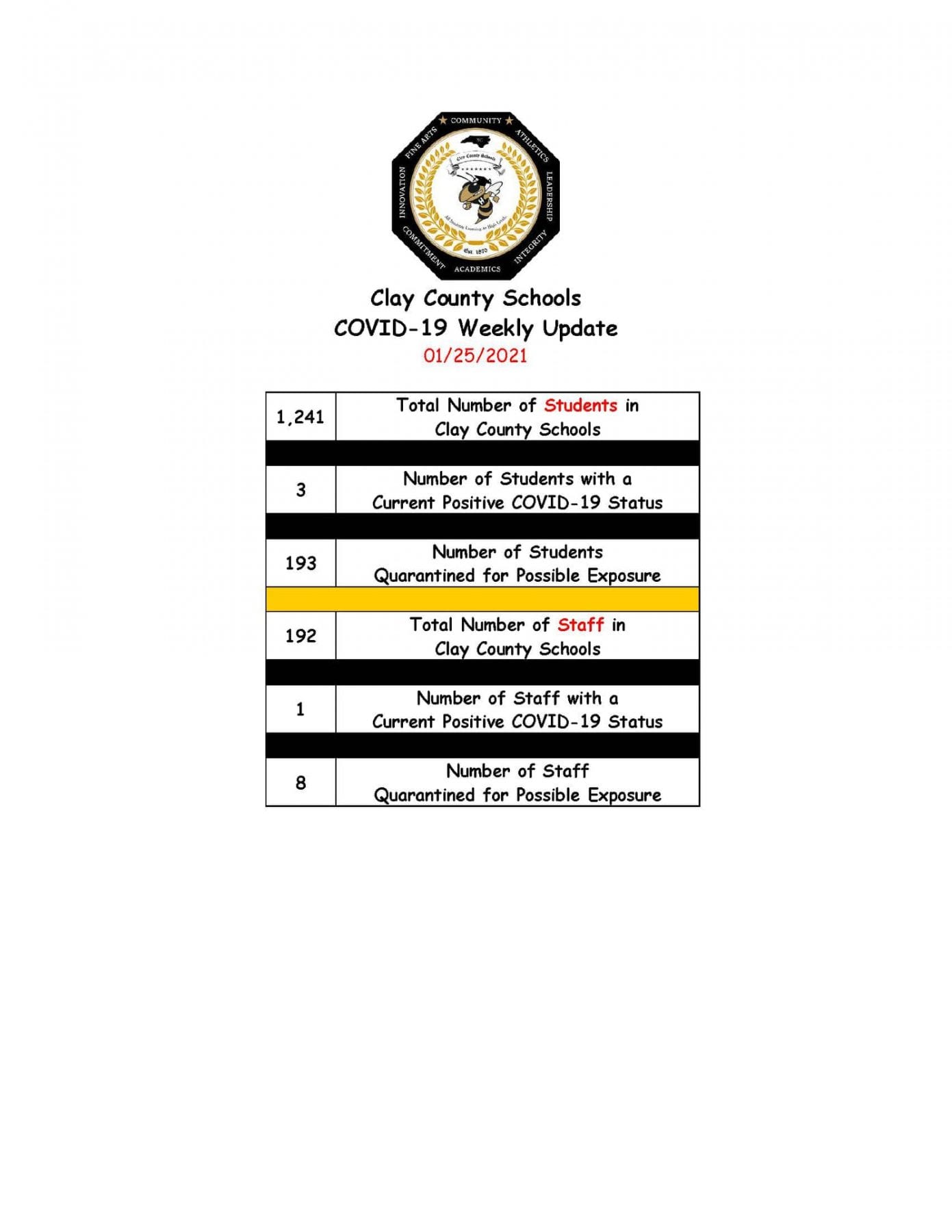
Clay County Schools going remote until February 7
Clay County Schools, News January 25, 2021
Governor Cooper Extends Modified Stay At Home Order
News, Press Release January 8, 2021
Governor Cooper extended North Carolina’s Modified Stay At Home Order that requires people to be at home from 10 pm – 5 am to last through at least Friday, January 29. Secretary Cohen also issued a Secretarial Directive with stark warnings for North Carolinians to avoid indoor spaces without masks and gatherings between households. Read here for more details on the Secretarial Directive.
“We have turned the page on a new year – one that we’re hoping will bring better times. But as we know, the virus didn’t disappear at midnight on December 31,” Governor Cooper said. “In fact, in North Carolina, we have seen some of our highest case counts, percent positives, hospitalizations and ICU bed usage numbers in the past few days. No matter where you live, work, worship or play, COVID-19 remains a deadly threat, and we must treat it that way.”
“We are in a very dangerous position. North Carolinians need to take immediate actions to save lives, slow the spread of the virus, and protect hospital capacity so that medical care is available to anyone who may need it, whether for COVID-19 or for any other reason,” said NCDHHS Secretary Mandy K. Cohen, M.D.
Dr. Cohen provided an update on North Carolina’s data and trends.
Trajectory in COVID-Like Illness (CLI) Surveillance Over 14 Days
- North Carolina’s syndromic surveillance trend for COVID-like illness is increasing.
Trajectory of Confirmed Cases Over 14 Days
- North Carolina’s trajectory of cases is increasing.
Trajectory in Percent of Tests Returning Positive Over 14 Days
- North Carolina’s trajectory in percent of tests returning positive is increasing.
Trajectory in Hospitalizations Over 14 Days
- North Carolina’s trajectory of hospitalizations is increasing.
In addition to these metrics, the state continues building capacity to adequately respond to an increase in virus spread in testing, tracing and prevention.
Testing
- Testing is widely available across the state.
Tracing Capability
- There have been more than 600,000 downloads of the exposure notification app, SlowCOVIDNC.
Personal Protective Equipment
- North Carolina’s personal protective equipment (PPE) supplies are stable.
Dr. Cohen also provided an update on North Carolina’s COVID-19 County Alert System map. There are now 84 counties designated as red (critical community spread) and 12 counties that are yellow (substantial community spread). Read the update to see where each county stands and how the system was designed.
Vaccine Efforts Underway
Governor Cooper and Dr. Cohen also highlighted North Carolina’s efforts to support the COVID-19 vaccination campaign. Governor Cooper has mobilized approximately 50 North Carolina National Guard personnel to support NCDHHS and North Carolina Emergency Management. The Guard will assist with administering the vaccine and logistics support for local entities.
“As we work to prevent the spread of COVID-19, we are also helping local hospitals and health departments to support their vaccine efforts. Getting the vaccine out quickly is the most urgent priority right now, and we will use everything and everyone needed to get the job done,” Governor Cooper said.
NCDHHS is onboarding more health care providers to administer the vaccine and sharing detailed guidance with providers to help them get the vaccine out more quickly. NCDHHS has also notified vaccine providers that future allocations will be based on how quickly they are able to get their supply out to eligible recipients. If an entity is not using their vaccine supply quickly enough or keeping the state database updated on their progress that will impact how much they are allocated going forward.
As the state moves into Phase 1b, local hospitals and other vaccine providers can now begin administering vaccines to those over age 75. Individuals should call their local health department or hospital to see if they have started to schedule vaccine appointments. A comprehensive list of local health department contact numbers can be found here.
Finally, NCDHHS and the state of North Carolina continue to work with communities around the state who may be hesitant to accept the vaccine when it is their turn. Governor Cooper and Dr. Cohen underscored that this vaccine was authorized after independent health experts reviewed the data from tens of thousands of trial participants.
Read Executive Order No. 188.
Clay County Students will attend classes two days a week
Community, News August 4, 2020
HAYESVILLE, N.C. – Clay County Schools have opted for a two cohort model once students return to class for the 2020-2021 year.
All schools except for the pre-k will follow an A/B schedule. Students will be broken into two groups. The A group will go to school on Monday and Tuesday while the B group attends class on Thursday and Friday. Wednesday will be a virtual learning day for students and a deep cleaning day at the school.
Parents and guardians can also select to place their children in entirely online learning.
At Hayesville Primary, elementary, and middle schools the teachers will change classes, not the students. Hayesville High School (HHS) students will be switching classes because the majority, 43.9 percent of parents voted for that option.
Homes with multiple school-age children will have those children placed in the same cohort so they can attend school on the same days. Cohorts will consist of 150 to 200 students.
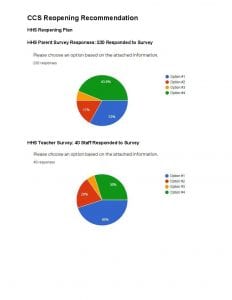
School survey responses from parents and teachers.
With the two day model, students can receive two days of attending all their 90-minute learning blocks in a controlled environment. They also have access to all school amenities including teachers, high-speed internet, counseling, and tech support.
This model isn’t the safest option due to the potential exposure of 150 to 200 students twice a week. It also places the heaviest load on teachers who must create lessons for in-person and remote children.
Schools will release information about which Clay County students will be in Cohort A and Cohort B on Wednesday, August 5 at 4:00. Students in Cohort A will attend each week on Monday and Tuesday beginning August 17. Students in Cohort B will attend each week on Thursday and Friday beginning August 20.
33 percent of parents selected fully remote learning in the return to school survey.
As for faculty, 45 percent of HHS staff were in favor of fully remote, and 30 percent chose the two cohort model.
If the school or county reaches a five percent COVID-19 infection rate, a decision will be made about closing the school buildings again. Currently, Clay County is at a less than one percent infection rate.
All students attending in-person classes will always be required to wear a mask with scheduled outdoor breaks. Faculty and students will be given five masks from the state. They must wash masks at home and can decorate the masks.
During break times, students will separate and safely remove their masks. They won’t be allowed to congregate in groups at any time during the school day. Students will always be sat six feet apart.
Remote learning children will be locked into the program for five weeks at a time. Parents must contact the school by September 11 if they wish to transition their child back into in-person instruction. Students can switch from in-person to remote at any time. In both instances, the principal must be notified ahead of time.
The Pre-K school will be fully open five days a week.
Clay County Schools Superintendent Dale Cole reviewed this model with stakeholders and the Clay County Health Department and all felt comfortable moving forward with this model.
North Carolina requires face coverings and social distancing for schools
Community, News July 14, 2020
RALEIGH: Governor Roy Cooper and North Carolina Department of Health and Human Services (NC DHHS) Secretary Dr. Mandy Cohen were joined by education and health leaders to announce health and safety plans for K-12 public schools for the new school year. Schools will open for in-person instruction under an updated Plan B that requires face coverings for all K-12 students, fewer children in the classroom, measures to ensure social distancing for everyone in the building, and other safety protocols.
“The most important opening is that of our classroom doors. Our schools provide more than academics; they are vital to our children’s’ health, safety and emotional development,” said Governor Cooper. “This is a difficult time for families with hard choices on every side. I am committed to working together to ensure our students and educators are as safe as possible and that children have opportunities to learn in the way that is best for them and their families.”
The Strong Schools NC Public Health Toolkit outlines the updated requirements for Plan B. Districts may choose to operate under Plan C, which calls for remote learning only, and health leaders recommend schools allow families to opt in to all-remote learning. Modifications have been made to Plan B since it was released in June to make it more protective of public health.
“After looking at the current scientific evidence and weighing the risks and benefits, we have decided to move forward with today’s balanced, flexible approach which allows for in-person instruction as long as key safety requirements are in place in addition to remote learning options,” said NCDHHS Secretary Mandy Cohen, MD. “We will continue to follow the science and data and update recommendations as needed. We ask every North Carolinian to do their part to slow the spread of COVID-19 and follow the three W’s: Wear a face covering when in public, Wait 6 feet apart, Wash your hands.”
Governor Cooper also announced that the state will provide at least five reusable face coverings for every student, teacher and school staff member in public schools. In June, the state provided packs of personal protective equipment to schools that included a two-month supply of thermometers, surgical masks, face shields, and gowns for school nurses and delegated staff who provide health care to students.
“Educators and stakeholders across our state have worked tirelessly to reopen our school buildings safely for our students, teachers, and staff. Today, we take another critical step towards that goal. We also know families need to choose the option that is best for their children, so all school districts will provide remote learning options,” said Eric Davis, Chairman of the State Board of Education.
“In-person education is important for children, and it happens in the context of a community. This plan strikes the right balance between health and safety and the benefits of having children learn in the classroom. We must all continue with proven measures to reduce COVID-19 transmission like wearing a face covering, keeping distance between people, and frequent hand and surface cleanings so we can move closer to safely re-opening public schools,” said Dr. Theresa Flynn, M.D., M.P.H., FAAP, a practicing pediatrician who serves on the Board of Directors for the North Carolina Pediatric Society and joined today’s announcement.
Under Plan B, schools are required to follow key safety measures that include:
- Require face coverings for all teachers and students K-12
- Limit the total number of students, staff and visitors within a school building to the extent necessary to ensure 6 feet distance can be maintained when students/staff will be stationary
- Conduct symptom screening, including temperature checks
- Establish a process and dedicated space for people who are ill to isolate and have transportation plans for ill students
- Clean and disinfect high-touch surfaces in the school and transportation vehicles regularly
- Require frequent hand washing throughout the school day and provide hand sanitizer at entrances and in every classroom
- Discontinue activities that bring together large groups
- Limit nonessential visitors and activities involving external groups
- Discontinue use of self-service food or beverage distribution
In addition, schools are strongly recommended to follow additional safety measures that include:
- Designate hallways and entrance/exit doors as one-way
- Keep students and teachers in small groups that stay together as much as possible
- Have meals delivered to the classroom or have students bring food back to the classroom if social distancing is not possible in the cafeteria
- Discontinue activities that bring together large groups
- Place physical barriers such as plexiglass at reception desks and similar areas
More details can be found in the Strong Schools NC Public Health Toolkit. Read the Screening Reference Guide for schools and the Infection Control and PPE Guidance.
In addition to the announcement about school plans, Governor Cooper shared that North Carolina will remain paused in Safer At Home Phase 2 after the current Executive Order expires on Friday, July 17.
“As we continue to see rising case numbers and hospitalizations, we will stay in Safer At Home Phase 2 for three more weeks,” said Governor Cooper. “Our re-opening priority is the school building doors, and in order for that to happen we have to work to stabilize our virus trends.”
School Groups on Today’s Public School Announcement
“While all school re-entry plans have their challenges during this pandemic, our superintendents, principals, and other school leaders will continue to prioritize student and staff safety in reopening schools under the cautious parameters outlined today by the Governor,” said North Carolina Association of School Administrators Executive Director Katherine Joyce. “We look forward to continuing work with the Governor, the General Assembly, and other state leaders to ensure our schools have the support needed to get student learning back on track in the safest manner possible in each local district.”
“I recognize Governor Cooper faced a very difficult decision. The good news is that local school boards can now begin to officially put their school reopening plans in motion,” said Brenda Stephens, President of the North Carolina School Board Association. “While the current situation may not be ideal for all, I’m confident North Carolina’s educators will continue to provide students with the best education possible.
To see the press briefing click here: https://www.facebook.com/watch/?v=591404655097644
North Carolina announces statewide COVID-19 testing, results reporting required
News July 7, 2020
RALEIGH — The North Carolina Department of Health and Human Services (NCDHHS) took action to decrease barriers to COVID-19 testing by issuing a Statewide Standing Order for COVID-19 Diagnostic Testing, as well as a State Health Director Temporary Order on COVID-19 Diagnostic Test Reporting.
These actions will help to increase access to testing across the state, especially for members of historically marginalized populations, and increase reporting of North Carolina test results, both positive and negative, to the state.
“Testing is an important component of the state’s strategy to slow the spread of the virus, and today’s order will make it easier for North Carolinians to get tested,” said NCDHHS State Health Director Elizabeth Cuervo Tilson, M.D.
The Statewide Standing Order allows testing sites to collect and submit samples to a laboratory for COVID-19 testing without requiring a specific order and authorizes testing sites to receive results directly from laboratories. This will facilitate community-based testing sites and reduce barriers to testing, especially for members of historically marginalized populations who may be less likely to have a medical home.
Read the Statewide Standing Order for COVID-19 Diagnostic Testing here.